The Compliance Gap Is Not the Same for Every Industry. Here Is What California’s Data Rules Actually Require of Yours.
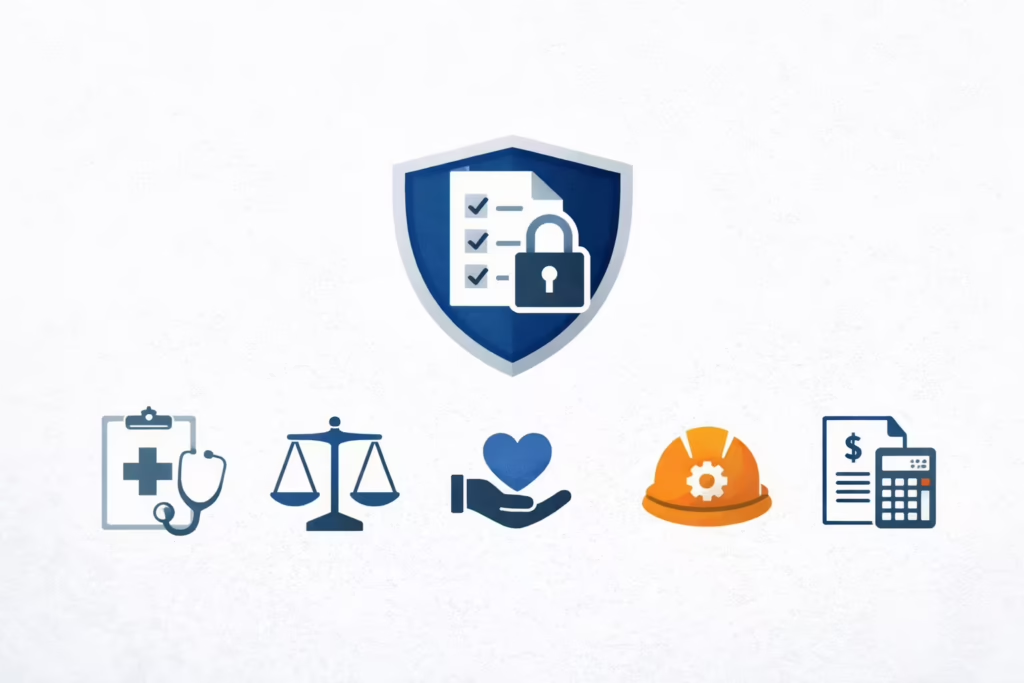
California’s data privacy and cybersecurity requirements do not land the same way across every industry. The legal frameworks differ. The data profiles differ. The specific obligations that apply, and the gaps that tend to go unaddressed, are different for a healthcare organization than they are for a law firm, a CPA practice, a nonprofit, or a construction company.
Most compliance coverage treats these industries as if they face the same problem. They do not. A construction firm’s biggest exposure is usually access that outlives the project. A law firm’s is often the email chain no one secured. A nonprofit may not be covered by CCPA at all, but still carries real risk that the exemption does not eliminate.
What follows is a breakdown of how California’s current requirements apply specifically to the five verticals we see most often in Greater Sacramento, where the obligations sit, and where the gaps actually appear.
Healthcare: Three Overlapping Frameworks and No Room for Error
Healthcare organizations in California are regulated by three separate bodies of law simultaneously: HIPAA at the federal level, the California Confidentiality of Medical Information Act (CMIA), and CCPA/CPRA for data that falls outside protected health information.
HIPAA is the floor. CMIA is frequently stricter, and where it is, California law controls.
The CMIA has been expanding through targeted legislation. AB 352, effective July 1, 2024, requires organizations that electronically store medical information related specifically to gender-affirming care, abortion and abortion-related services, and contraception to implement technical controls: limiting access to authorized individuals, preventing out-of-state disclosure, and segregating that data from other parts of the patient record. AB 254 extended CMIA coverage to reproductive or sexual health application information collected by digital health services. AB 2089 brought mental health digital services into the law’s scope, covering mental health application information collected by mobile apps or websites marketing themselves as mental health platforms.
These are narrow but consequential expansions. If your organization handles any of these categories, or uses a digital platform that does, the obligation is technical, not administrative. You cannot satisfy it with a privacy notice update.
CMIA carries a private right of action. An unauthorized disclosure, even an accidental one, can trigger litigation without proof of intent. The civil penalty scale runs from $2,500 per negligent violation to $250,000 per willful violation made for financial gain.
For healthcare organizations that collect personal information outside of clinical records, such as website behavior, marketing lists, and billing data not classified as PHI, CCPA/CPRA applies in parallel. The 2026 regulations added new risk assessment requirements for covered businesses engaged in higher-risk processing, which can include certain uses of health data.
Fragmented access control. Data is segregated on paper. In practice, broad permissions were granted during a system rollout and never reviewed. When a breach occurs, the organization cannot demonstrate it took reasonable safeguards, which is the legal standard CMIA, HIPAA, and CCPA all apply.
Legal: Client Confidentiality Is Now a Cybersecurity Obligation
Law firms handle some of the most sensitive personal and business information in any economy. Client communications, litigation strategy, financial records, estate documents, HR files for clients under investigation. None of it is supposed to leave the firm. All of it is a high-value target.
California’s new regulations treat professional service firms that collect and process personal information as covered businesses under CCPA/CPRA. If a firm meets the applicable revenue or data-volume thresholds, and some mid-sized Sacramento firms may meet those thresholds depending on revenue and the volume of California resident data they process, the 2026 compliance obligations apply.
That includes risk assessments before initiating processing activities that carry elevated privacy risk, and cybersecurity audits on a rolling schedule based on firm revenue. The first audit submissions for firms with revenue under $50 million are due by April 1, 2030, but those audits must cover a period beginning in 2029. That means programs need to be operational well before the filing deadline. Firms that wait until 2028 to begin building a cybersecurity program will not have a mature one ready to audit.
SB 446, also effective January 1, 2026, tightened breach notification timelines. When 500 or more California residents are affected, the firm must notify the California Attorney General within 15 calendar days of notifying affected individuals. That window requires an incident response plan that is already written, tested, and understood, not assembled during the breach.
California ethics guidance points firms toward protective measures such as encryption, password protection, access management, and documented security procedures as part of their duty to protect client confidentiality. An attorney who loses a client file to ransomware is not just facing a legal malpractice issue. They may be facing a regulatory one.
Unprotected email. Client files travel over unencrypted email chains. Credentials for cloud document platforms are shared across staff. There is no MFA. None of that meets the reasonable security standard the law applies.
Accounting and Financial Services: Tax Data Is Personal Information
Accounting firms and financial services organizations hold a concentrated profile of personal information. Tax identification numbers. Bank account data. Income records. Business financial statements. Payroll details. In the language of CCPA/CPRA, virtually all of it qualifies as personal information, and significant categories qualify as sensitive personal information, which triggers the most stringent compliance tier.
The 2026 regulations require covered businesses engaged in certain higher-risk processing involving sensitive personal information to complete risk assessments. For many accounting firms, that can reach a large share of client-facing processing activity. The assessment must evaluate potential privacy harms, document the safeguards in place, and be signed off by executive leadership.
Financial services organizations operating in California also need to be aware of the layering between CCPA/CPRA and any federal frameworks they operate under. Gramm-Leach-Bliley applies to certain financial institutions. Where both apply, the stricter standard governs. California tends to be the stricter standard.
SB 446’s accelerated breach notification requirements hit this vertical hard. A breach affecting tax records or financial account data for 500 or more California residents means a 15-day notification window to the Attorney General. That requires documented incident response capability, not just a policy document on a shared drive.
The client portal. Firms implement a client document exchange platform, often a low-cost or legacy tool, and assume the vendor manages security. The vendor manages their infrastructure. Access controls, authentication policies, and what happens when a former client’s credentials are never revoked are the firm’s responsibility. That is where breaches originate.
Nonprofits: Exempt From CCPA, But Not From Consequence
The CCPA generally does not apply to nonprofit organizations. The law covers for-profit businesses meeting specific revenue or data-volume thresholds. Most Sacramento-area nonprofits fall outside that definition. That is the starting point, and it matters.
But exemption from CCPA is not the same as exemption from risk. And in specific situations, the lines are less clear than they appear. Nonprofits that operate controlled subsidiaries or certain joint ventures with for-profit entities may find those structures pull them into coverage. Organizations should assess their own structure rather than assume blanket exemption.
More practically, nonprofits serving vulnerable populations including social services, behavioral health, housing assistance, and domestic violence support collect and hold information about people who face real-world harm if that data is exposed. The regulatory framework may not directly require a particular control. The ethical and operational obligation still does.
Healthcare-adjacent nonprofits face a more specific compliance question. AB 2089 brought certain digital mental health services under CMIA’s scope regardless of whether the provider is a licensed clinical organization. If your nonprofit uses a mobile app or web platform that markets itself as providing mental health services and collects mental health application information, that platform and by extension your organization’s relationship with it may carry CMIA obligations.
California’s breach notification law (SB 446, effective January 1, 2026) applies to any organization that maintains personal information about California residents and experiences a qualifying breach, not just for-profit businesses. Nonprofits that hold donor data, client records, employee files, and program participation information should understand what a breach notification obligation looks like and whether they have the internal capacity to meet a 15-day Attorney General notification window.
Vendor management. A program transitions to a new case management platform or communication tool. No one reviews the vendor’s security posture, data handling practices, or what happens to data if the contract ends. That gap is the organization’s liability, not the vendor’s.
Construction: Credentialing, Subcontractors, and the Access Problem
Construction firms manage a category of cybersecurity risk that does not fit neatly into the standard data privacy framework, but the exposure is real and growing.
Projects generate access. Subcontractors, consultants, and administrative staff receive credentials to shared file systems, project management platforms, financial data, and communication tools. When the project closes, that access often stays open. Not because anyone decided to leave it open. Because no process existed to close it.
We wrote about this problem specifically in the context of Sacramento construction firms. The access accumulation is not a single event. It compounds across every project that closes without a formal off-boarding process. After ten projects, the exposure profile can be significant.
From a California data privacy standpoint, construction firms that operate payroll systems, collect employee and subcontractor personal information, or maintain client financial records are subject to CCPA/CPRA obligations based on the same revenue and data-volume thresholds that apply to any business. SB 446’s stricter breach notification requirements apply equally.
The 2026 ADMT and risk assessment rules can become relevant for firms that use automated tools in ways that materially influence decisions about individuals, and the scope is broader than many technology users realize.
Distributed data with no map. Information is spread across project folders, email chains, cloud platforms, and accounting software, often managed by small administrative teams without formal IT oversight. A Cybersecurity Risk Assessment maps that environment as it actually exists, not as it is assumed to exist.
What All Five Industries Have in Common
For organizations covered by CCPA/CPRA, California’s 2026 regulations effectively assume a documented cybersecurity program already exists or is being built in a form that can be assessed and, on a phased schedule, certified. For organizations outside direct CCPA coverage, the same operational expectations still apply if they hold sensitive data and need to manage breach, vendor, and access risk responsibly.
Organizations that do not have that program in place cannot satisfy those requirements by updating a policy document. They need to understand what data they hold, how it flows, who has access to it, what controls protect it, and what happens when something goes wrong.
That is the work of a Cybersecurity Risk Assessment. It is also the foundation required before any of the later compliance steps become possible.
What Vision Quest Finds When We Look
When we conduct a Cybersecurity Risk Assessment with a Greater Sacramento organization, we are not looking for perfect security. We are looking for the gap between what an organization believes its posture is and what it actually is.
That gap is almost always present. It is usually larger than expected. And it is never in the place leadership assumed it would be.
Compliance does not require a large organization. It requires clear ownership, documented processes, and controls that match the data you actually hold. Most organizations in our market are closer than they think. They just do not have visibility into where the work needs to happen first.
Talk to Us
If you are in any of the industries covered above and you do not have a clear picture of your compliance exposure under California’s 2026 regulations, the right starting point is a conversation. We work with organizations across Greater Sacramento to assess exactly where they stand, what is required, and what a practical path to compliance looks like for their specific environment.
Contact Us